In recent years, pouch cells have become increasingly popular in the battery industry, especially for electric vehicles (EVs), consumer electronics, and energy storage systems. Among the methods of constructing pouch cells, stacking and winding are two commonly used techniques. Each method has its advantages, but in many cases, stacking has emerged as the preferred choice over winding. The benefits of stacking over winding for pouch cells are vast, from improved energy density to enhanced manufacturing efficiency.
In this article, we’ll explore the differences between stacking and winding, the advantages of choosing stacking for pouch cells, and how battery stacking machines are crucial in this process. Additionally, we’ll discuss why stacking has become the go-to method for modern battery manufacturers.
What are Pouch Cells?
Before diving into the details of stacking and winding, it’s important to understand what pouch cells are. A pouch cell is a type of lithium-ion battery that is designed with a flexible, flat, and lightweight aluminum laminate pouch. The design offers several advantages:
Lightweight: Pouch cells are lighter compared to other battery formats, making them ideal for portable electronics and electric vehicles.
High Energy Density: Their design allows for higher energy density and a more compact size, making them suitable for applications requiring high storage capacity.
Flexible Shape: Pouch cells can be made in various shapes and sizes to fit specific designs, unlike other battery formats like cylindrical or prismatic cells.
Pouch cells are commonly used in EVs, smartphones, tablets, and wearable devices, and their production requires careful consideration of design, construction, and performance characteristics.
Stacking vs. Winding for Pouch Cells
There are two primary methods used to assemble pouch cells: stacking and winding. Both methods involve layering the electrode materials, but they differ significantly in their approach.
Winding Process
In the winding process, the anode, separator, and cathode are continuously wound around a core, creating a cylindrical shape. The wound electrode assembly is then inserted into a pouch, and the battery is sealed.
Winding Characteristics:
The winding technique is commonly used for cylindrical and prismatic cells.
It requires the electrodes and separators to be tightly wound around a central core, creating a spiral shape.
The winding process is generally automated and faster, making it suitable for high-volume production.
However, winding can have some limitations when applied to pouch cells, such as:
Space Efficiency: The wound structure may not fully optimize the available space inside the pouch, leading to inefficient use of volume.
Manufacturing Complexity: Winding may lead to variations in the uniformity of the electrode layers, which can affect the battery's overall performance.
Stacking Process
Stacking, on the other hand, involves laying the anode, separator, and cathode in flat layers, one on top of the other. The stacked layers are then placed into the pouch and sealed. This method is typically used for pouch cells and is favored for its ability to achieve a more efficient energy density.
Stacking Characteristics:
In stacking, the electrodes are arranged in layers, which allows for a more compact and optimized use of space within the pouch.
The stacking process enables precise control over the thickness and uniformity of the electrode layers.
The method is highly adaptable to different pouch shapes and sizes.
Despite being more labor-intensive and slower than winding, stacking has several key advantages when producing pouch cells.
Why Choose Stacking Over Winding for Pouch Cells?
1. Increased Energy Density
One of the most significant advantages of the stacking method is that it allows for more efficient use of space within the pouch. When electrodes are stacked, there is a more compact arrangement of the active materials, which leads to a higher energy density. Since energy density is directly related to how much material can be packed into the battery, stacking provides a clear advantage in terms of maximizing the capacity of the pouch cell.
Uniformity: Stacking ensures uniformity in the layering of materials, allowing for better ion diffusion and reducing inefficiencies that could arise from irregular layering in winding.
Higher Capacity: By eliminating the central core used in winding, stacking allows for more active material to be included in the pouch, resulting in higher overall capacity.
2. Improved Thermal Management
Heat dissipation is a critical concern for battery performance and longevity. In the stacking process, the electrodes are evenly arranged, which promotes more uniform heat distribution across the surface area. The lack of the central core (used in winding) in stacked cells also facilitates better thermal conductivity.
Uniform Temperature: Because the heat is distributed evenly across the layers, stacked pouch cells are less prone to hot spots, which can lead to thermal runaway or other safety concerns.
Longer Life Cycle: Better heat management contributes to a longer battery life, as the battery is less likely to experience temperature-induced degradation of materials.
3. Greater Manufacturing Efficiency
Although stacking requires more careful handling of the electrodes, it offers improved efficiency in the long run, especially when using automated stacking machines. The precise arrangement of layers results in fewer defects and higher consistency between individual cells.
Fewer Defects: Stacking allows for better control over the electrode material alignment, reducing the chances of misalignments, tears, or wrinkles in the electrode layers.
Automated Stacking Machines: The use of battery stacking machines enables high-speed production while maintaining precision and quality control, making it easier to scale production for large quantities.
4. Space Efficiency and Flexibility in Design
Stacking provides more flexibility in designing custom-shaped pouch cells. The method allows for the battery to be shaped in ways that optimize space in different devices, such as smartphones, electric vehicles, and wearable devices. Additionally, the flat layering ensures that the electrodes are arranged efficiently, reducing wasted space in the pouch.
Design Flexibility: Stacking makes it easier to design compact and efficient battery cells that fit into the desired form factor, whether for high-capacity applications or smaller, lightweight products.
No Need for Central Core: Unlike winding, which requires a central core, stacking eliminates this unnecessary material and increases the available space for active electrode materials.
5. Higher Consistency and Better Performance
In battery production, achieving uniformity is key to ensuring consistent performance across all cells. With the stacking process, layer-to-layer consistency is easier to achieve, and the chances of having variations in the thickness of the electrodes are significantly reduced.
Stable Performance: With uniformity in the structure, the battery can operate with consistent voltage levels, efficiency, and cycle life, ensuring reliable performance for the end-user.
Less Variation Between Cells: Stacking ensures that the physical properties of each cell, including the thickness and alignment of layers, remain consistent, resulting in better quality control.
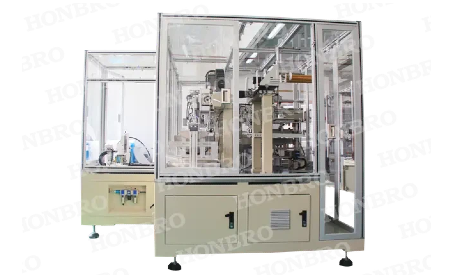
Battery Stacking Machines: The Key to Efficiency
Battery stacking machines are integral to achieving the high level of precision and consistency required in the stacking process. These machines are designed to automatically stack the anode, cathode, and separator layers with high accuracy.
Machine Type | Description | Applications |
Automatic Stacking Machines | Fully automated machines designed to stack electrodes quickly and with high precision. | Large-scale production of lithium-ion batteries for EVs and consumer electronics |
Semi-Automatic Stacking Machines | These machines require some manual input but still provide high accuracy in stacking layers. | Medium-scale production where flexibility and control are needed. |
Manual Stacking Stations | Workers manually place each electrode layer, ensuring high precision for custom orders or small batches. | Small-scale production or specialized battery designs |
Battery stacking machines are crucial in automating the assembly process, improving throughput, and ensuring uniformity in the electrodes. These machines ensure that the process is efficient and produces high-quality cells consistently.
Challenges in Stacking and How to Overcome Them
1. Material Handling
Handling thin electrodes can be challenging, as they are fragile and prone to damage. Improper handling can lead to wrinkles or tears in the electrode material, which could affect the battery’s performance. Advanced stacking machines are designed with features like automated feeders, vacuum suction, and gentle material handling to reduce damage during stacking.
2. Consistency in Layering
Achieving perfect layer-to-layer alignment is crucial to the success of the stacking process. If the layers are not stacked uniformly, it can lead to uneven energy distribution and decreased battery performance. Regular maintenance and calibration of stacking machines ensure that alignment remains precise.
3. Increased Complexity for Custom Shapes
While stacking is great for creating standard pouch cells, custom shapes and sizes can present additional challenges in the stacking process. However, advances in machine design and custom tooling allow manufacturers to adapt stacking machines for specific applications, such as wearable devices or thin-form-factor batteries.
Conclusion
Choosing stacking over winding for pouch cells has become a popular decision among battery manufacturers for a variety of reasons. Stacking offers better energy density, improved performance, enhanced safety, and greater flexibility in design. Precision in stacking is crucial, and battery stacking machines play an essential role in ensuring that electrodes are aligned and stacked accurately. Despite some challenges, the stacking method continues to be a favored choice for lithium-ion batteries, electric vehicles, and renewable energy storage systems.
At HONBRO, we specialize in providing high-quality battery stacking solutions that ensure your production processes are efficient and produce top-performing batteries. Our state-of-the-art battery stacking machines help you meet the highest standards in battery manufacturing, ensuring superior quality, precision, and performance for your applications.
FAQ
Q: Why is stacking preferred over winding for pouch cells?
A: Stacking offers higher energy density, improved thermal management, and greater space efficiency compared to winding, making it ideal for modern applications like electric vehicles.
Q: What are the advantages of battery stacking machines?
A: Battery stacking machines automate the process of electrode alignment, ensuring high precision, uniformity, and efficiency in large-scale battery production.
Q: How does stacking affect battery performance?
A: Stacking ensures consistent energy distribution, reduces internal resistance, and improves the lifespan of the battery, leading to better overall performance.
Q: Are there challenges in using stacking for pouch cells?
A: Yes, challenges include material handling, maintaining consistent layering, and adapting to custom battery shapes. However, these issues can be mitigated with advanced machines and proper calibration.


